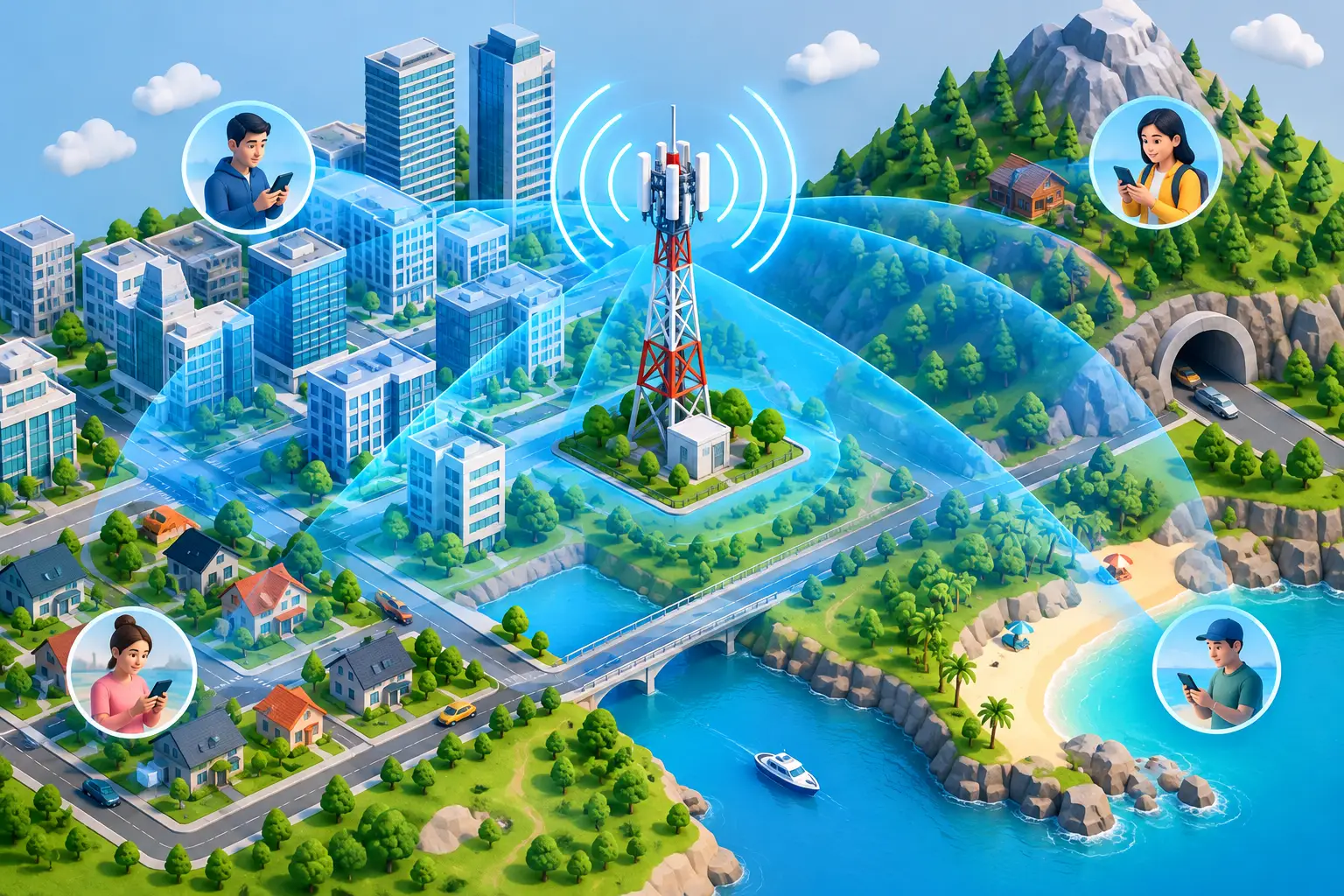
A full signal bar can disappear the moment you step into an elevator, drive behind a hill, or enter a crowded stadium. That is not necessarily a carrier failure. It is the visible result of how mobile network coverage works: a constantly changing connection between your phone, nearby radio equipment, available spectrum, and the people using the network around you.
For consumers and businesses, coverage is more than a map color or a marketing promise. It affects whether a payment terminal can process a sale, a remote worker can join a video call, or a family can reach each other during a busy commute. Understanding the basics makes those signal bars far less mysterious.
Mobile Coverage Starts With Cells, Not One Giant Signal
Mobile networks are built from many small service areas called cells. Each cell is served by radio equipment, usually mounted on a tower, rooftop, utility pole, or other elevated structure. Your phone communicates with the closest suitable cell using radio waves, sending and receiving small bursts of data thousands of times per second.
A cell tower does not blanket an entire city with equal power. Its antennas are often divided into sectors, commonly aimed in different directions. This lets an operator reuse the same radio frequencies across a wide region without every user competing for one enormous shared signal.
When you move, your phone measures neighboring cells in the background. If another cell becomes the better option, the network transfers your connection to it through a handoff. Ideally, this happens without interrupting a call or video stream. On a highway, however, the phone may switch cells frequently, which helps explain why coverage quality can change from mile to mile.
The tower is only the radio-facing part of the system. Behind it sits the transport network, often fiber, that carries traffic to the carrier’s core network and then out to the internet or another phone. Strong radio signal alone cannot guarantee a fast experience if that backhaul connection or the wider network is under strain.
Spectrum Is the Airspace Mobile Networks Share
Wireless carriers operate in licensed sections of radio spectrum. Think of spectrum as organized airspace for signals. Each band has different physical characteristics, and those characteristics shape what coverage feels like.
Low-band spectrum travels farther and passes through walls more effectively. It is valuable for rural coverage and indoor service, although it may not provide the highest speeds when many people are active. Mid-band spectrum offers a useful balance of range and capacity, making it a major focus for modern 5G expansion. High-band spectrum can carry huge amounts of data over short distances, but it struggles with obstacles such as walls, trees, and even heavy rain in some conditions.
That trade-off is why a carrier can have excellent coverage across a region but uneven performance in dense urban blocks. It also explains why a 5G icon does not automatically mean the fastest possible connection. The icon describes the network technology your phone is using, not the amount of spectrum available, your distance from the site, or current congestion.
Why 4G and 5G Often Work Together
5G is not one single frequency or network experience. Many deployments use 5G alongside 4G LTE, with phones moving between them as conditions change. Early 5G networks often relied on 4G infrastructure for parts of their operation, while newer standalone 5G networks can handle more functions directly on 5G systems.
For everyday users, the practical point is simple: the best network is usually the one that can intelligently combine coverage, capacity, and compatible devices where you are. A well-built LTE connection can outperform a weak or overloaded 5G connection.
Why Coverage Maps Are Useful but Not Final
Coverage maps are a starting point, not a street-level guarantee. They typically model outdoor coverage under expected conditions. Real environments are messier. A map cannot fully account for the concrete in your office, the metal coating in a building’s windows, a new construction project, or the exact room where you place your phone.
Terrain matters too. Hills, valleys, forests, and coastal geography can weaken or redirect radio signals. In rural areas, towers are spaced farther apart because serving large distances is expensive and fewer customers are concentrated in one place. A low-band signal may reach a remote road, yet data speeds can still be modest because that cell is serving a broad area with limited capacity.
Dense cities create the opposite challenge. Towers may be nearby, but buildings block signals and thousands of devices compete for resources. Operators address this with more sites, rooftop antennas, small cells, and dedicated indoor systems. These smaller coverage points add capacity precisely where demand is highest, such as business districts, transit hubs, venues, and shopping areas.
Signal Strength Is Not the Same as Network Quality
The bars on a phone are a rough indicator of signal strength. They do not show the full story. A phone can display several bars while data feels slow because the cell is crowded. It can also show fewer bars but still deliver a reliable connection if interference is low and the network has available capacity.
Several factors work together:
- Signal strength measures how powerfully your phone receives the network.
- Signal quality reflects how clean that signal is compared with interference and background noise.
- Capacity is the amount of network resource available for all users in that cell.
- Latency is the delay before data begins moving, which matters for calls, gaming, cloud tools, and real-time collaboration.
This is why a packed concert, airport, or downtown event can challenge a network even with towers all around. Every connected phone, smartwatch, tablet, payment device, and hotspot is asking for time on the same local network resources. Carriers can add spectrum and equipment, but peak demand remains a moving target.
The Building Problem: Why Indoor Coverage Can Be Hard
Modern buildings are often designed to control heat, noise, and sunlight. Unfortunately, the same materials can weaken cellular signals. Reinforced concrete, steel framing, energy-efficient glass, and underground construction are common barriers.
Businesses that depend on mobile connectivity may use indoor cellular systems such as distributed antenna systems or small cells. These systems bring carrier signal deeper into offices, hospitals, warehouses, and large public spaces. Wi-Fi calling can also help consumers and teams make calls through a reliable Wi-Fi connection when cellular coverage indoors is limited.
There is no universal fix. Wi-Fi calling is useful only when Wi-Fi itself is stable, while indoor cellular equipment takes planning and investment. For a small business, testing service inside the actual building before choosing a carrier is often more valuable than relying on an area-wide coverage map.
Devices and Settings Shape the Experience Too
A network can only use the capabilities built into the device. Newer phones may support more spectrum bands, advanced antenna designs, carrier aggregation, and newer 5G features. An older or budget device may connect successfully but miss the bands that deliver better indoor coverage or faster speeds in a given market.
Your phone case, battery-saving settings, software version, and network mode can also affect results at the margins. If service suddenly performs poorly, restarting the device, updating its software, and checking whether the issue occurs in several locations can help separate a phone problem from a network problem.
For business buyers, this has a procurement angle. A lower upfront device price can create frustration later if employees cannot access the bands used most heavily by the chosen carrier. Device compatibility should be part of the connectivity decision, especially for field teams and mobile-first operations.
What Better Coverage Means Next
Mobile coverage is evolving from large towers serving wide areas toward a more layered model. Low-band spectrum will continue to support broad reach, while mid-band 5G, small cells, fiber backhaul, and smarter network software will build capacity where people work and gather.
Satellite-to-phone services are also beginning to fill narrow but meaningful gaps, particularly where traditional towers cannot reach. They are not a replacement for everyday urban mobile broadband, but they point toward a future where being completely disconnected becomes less common.
The most useful way to judge coverage is not by the logo on a phone or the number of bars alone. Test it where life and business actually happen: at home, in the office, on the commute, and in the places where a missed connection has real consequences. That practical view turns mobile coverage from a vague promise into a technology decision you can use with confidence.