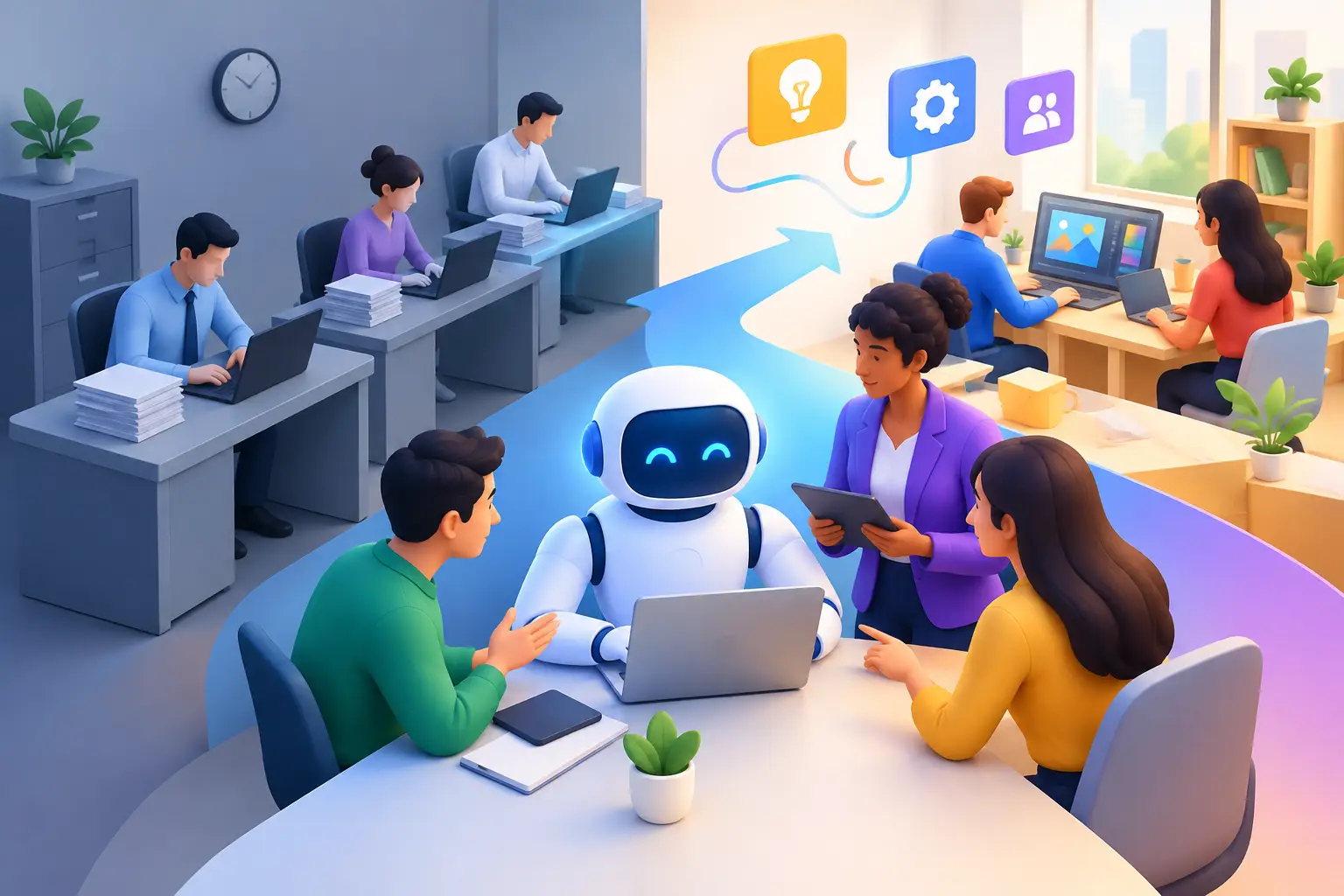
A customer support agent asks an AI assistant to summarize a long ticket history. A designer generates first-draft concepts in minutes. A small business owner automates invoice follow-ups that once took an afternoon. These are not distant experiments. They show how does AI affect jobs in a practical sense: it changes the tasks inside a job before it necessarily removes the job itself.
For workers and businesses, the real story is less about a sudden replacement of people by machines and more about a fast reorganization of work. AI is taking on repeatable digital tasks, increasing the value of judgment and communication, and creating new pressure to learn how these tools fit into daily operations.
How Does AI Affect Jobs Across the Economy?
AI affects jobs in three connected ways. It can automate a task, assist a person with a task, or create entirely new work around the technology. The result depends on the industry, the quality of available data, the cost of adopting AI, and whether errors carry serious consequences.
Tasks with clear rules and large volumes of digital information are often easiest to automate or accelerate. Think of sorting emails, transcribing meetings, scheduling appointments, checking standard documents, producing basic reports, or answering common customer questions. Generative AI also changes knowledge work by producing rough drafts of text, code, images, research summaries, and presentations.
That does not mean every role involving those tasks disappears. A financial analyst may spend less time cleaning spreadsheets and more time explaining what the numbers mean. A marketing team may generate more campaign variations but still need people to understand customers, protect brand voice, and decide which message deserves investment. In many cases, AI shifts the balance of work rather than eliminating the position.
The biggest immediate impact may be on job design. Employers can expect a smaller share of time spent on administrative work and a larger share spent on review, decision-making, relationship building, and problem-solving. That can be empowering when companies invest in training. It can also be stressful when adoption is rushed and employees are asked to deliver more output without clearer roles or better support.
Jobs Most Likely to Change First
Office-based roles that handle predictable information are already feeling the effects. Customer service teams use AI to suggest responses and route requests. Human resources teams use it to organize job descriptions and summarize candidate notes. Software teams use coding assistants to speed up routine development and testing. Legal and finance professionals can use AI to review large sets of documents, flag patterns, and prepare first-pass analysis.
Creative work is changing too, but not in a simple replacement story. Writers, video editors, illustrators, and marketers can use AI to move from a blank page to an initial concept faster. The trade-off is that cheap, high-volume content can make originality, fact-checking, taste, and strategic thinking more valuable. When almost anyone can generate a passable draft, the people who can make it accurate, distinctive, and useful stand out.
Physical jobs are affected differently. AI often works alongside sensors, cameras, robotics, and industrial software in warehouses, manufacturing, logistics, agriculture, and maintenance. These systems can improve forecasting, detect defects, optimize routes, or identify equipment problems before downtime occurs. Human workers remain essential where conditions are unpredictable, safety matters, or dexterity and on-site judgment are required.
Care-focused professions also illustrate AI’s limits. Healthcare staff may use AI to organize notes, support imaging analysis, or reduce paperwork. Teachers may use it to create lesson materials tailored to different skill levels. Yet trust, empathy, accountability, and context cannot be handed over casually. A recommendation from software is not the same as a responsible decision by a qualified professional.
The Jobs AI Creates and Expands
AI is generating demand for roles that did not have the same visibility a few years ago. Businesses need people who can implement AI tools, improve workflows, evaluate outputs, protect sensitive information, and make sure systems are used fairly. Some of these roles are highly technical, such as machine learning engineers and data specialists. Others are business-facing, including AI product managers, automation consultants, compliance professionals, trainers, and domain experts who help shape useful prompts and policies.
More broadly, AI creates a premium on people who can connect technology to a real business problem. A small retailer does not need a complex model for its own sake. It needs better inventory decisions, faster customer communication, and fewer repetitive tasks. The person who can identify the right use case, set reasonable safeguards, and measure results can create major value.
This is why AI literacy is becoming a baseline career skill, much like search, spreadsheets, and collaboration software. AI literacy does not mean everyone must learn advanced programming. It means understanding what a tool can do, where it can fail, what data should not be entered, and how to verify an answer before using it.
Why Automation Does Not Affect Everyone Equally
The same AI tool can be an opportunity for one worker and a risk for another. A company that uses automation to grow may hire people into higher-value positions. A company focused only on cutting costs may reduce entry-level work, leaving fewer pathways for new talent to gain experience.
Entry-level knowledge jobs deserve special attention. Junior employees have traditionally built expertise by handling research, drafts, routine analysis, and administrative tasks. If AI handles more of that foundation work, employers need to intentionally create new learning opportunities. Otherwise, businesses may save time now while weakening their future talent pipeline.
Location, education, and access matter as well. Workers with reliable technology, training budgets, and supportive managers are more likely to benefit quickly. Those without access can fall behind even if they are highly capable. This makes employer-led education, affordable training, and clear workplace policies more than a nice extra. They are part of a competitive labor strategy.
Skills That Gain Value in an AI-Enabled Workplace
Technical skills remain valuable, especially data analysis, cybersecurity, cloud systems, and software development. But the human capabilities around those skills are gaining importance too. Strong communication helps employees turn AI-generated material into messages people can trust. Critical thinking helps them detect a confident but incorrect answer. Industry knowledge helps them recognize when a technically plausible suggestion would fail in the real world.
Adaptability matters because tools will keep changing. The most resilient workers are not those who know one platform perfectly. They are the ones who can learn a new system, test it on a real problem, document what works, and improve the process with colleagues.
For professionals looking to build momentum, a practical starting point is to choose one recurring task and use AI as an assistant rather than an autopilot. Compare its output with your usual process. Check facts, privacy risks, and time saved. Then learn how to explain the result in business terms: faster response times, fewer errors, more leads, or more time for customers.
What Businesses Should Do Now
Companies should begin with workflow questions, not tool shopping. Where are employees losing time? Which processes have frequent errors? Where could faster access to information improve customer experience? The answers reveal where AI may help and where it may introduce unacceptable risk.
A responsible rollout needs human review, clear data rules, and honest communication with staff. Employees are more likely to use AI well when they know what is allowed, how performance will be measured, and how the technology supports their role. A policy that simply says “use AI” is not enough. Teams need examples, training, and a way to report mistakes or concerns.
Businesses also need to resist the temptation to treat every AI output as reliable. Generative systems can invent details, repeat bias found in training data, or mishandle sensitive context. In areas involving hiring, finance, healthcare, customer records, or legal obligations, oversight is essential. Speed is valuable, but a fast mistake can cost far more than a slower, reviewed process.
The future of work will not be decided by AI alone. It will be shaped by the choices employers, workers, educators, and policymakers make around it. The strongest next step is simple: learn where AI can remove friction from your work, then invest the saved time in the judgment, relationships, and ideas that make human contribution matter even more.